Is Invisalign Right for Me? What It Can and Cannot Fix

Updated: 2 days ago
Invisalign works well for crowding, spacing, mild to moderate bite problems, teeth that drifted after old braces, and lining things up before cosmetic work. It struggles with big rotations, severe open or deep bites, jaw position problems, and cases that need extractions. A scan and a simulation tell us which group you are in before you commit to anything.
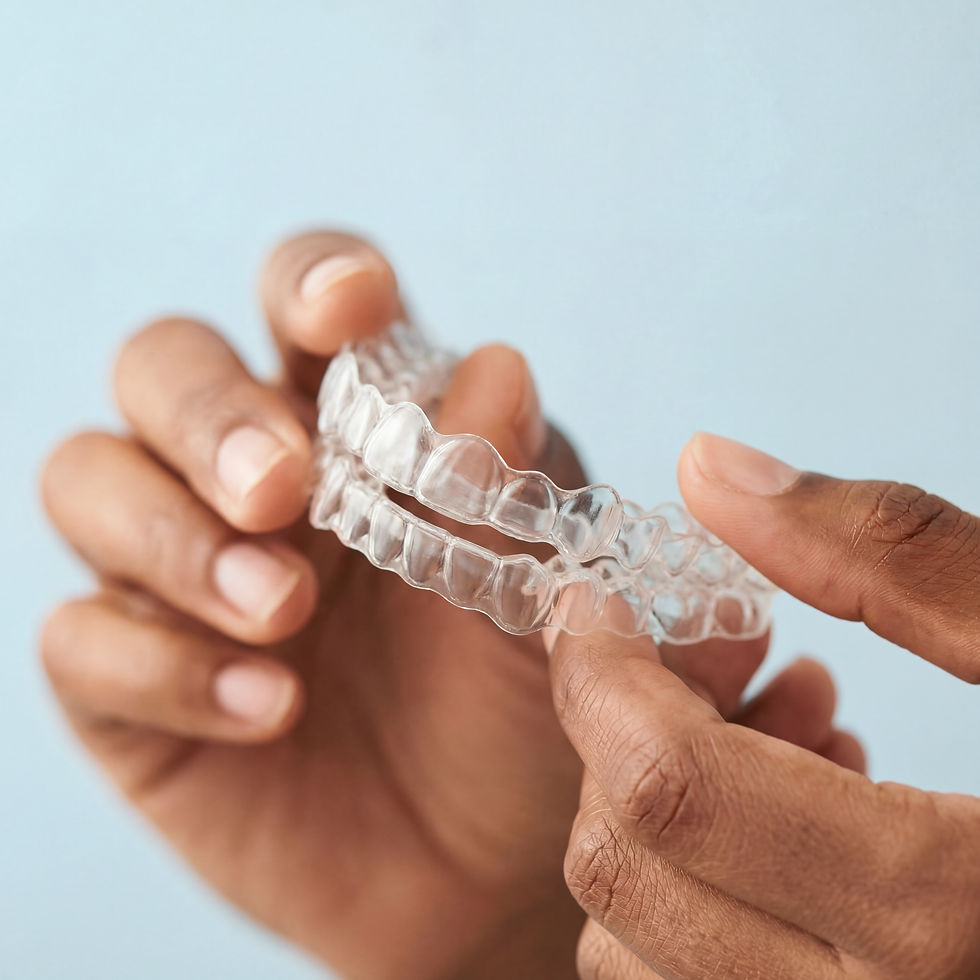
What does Invisalign actually do well?
Aligners are good at the kind of movement most adults in my chair are asking about. Crowding in the lower front teeth, the little overlap that showed up in your thirties, responds nicely because those teeth only need to slide a short distance and tip slightly. Spacing works the same way in reverse, closing gaps by walking teeth toward each other a fraction of a millimeter per tray.
Relapse after old braces is one of my favorite uses. If you had braces as a teenager, lost the retainer somewhere around college, and now one or two teeth have wandered, the teeth already know the way home. Those cases tend to be short and predictable.
Mild to moderate bite issues are fair game too. A modest overbite, a crossbite on a single tooth, a bite that is a little off because of crowding, those can all move with aligners, sometimes with small tooth-colored attachments or elastics to help the trays grip.
The last group is cosmetic alignment before veneers or bonding. If a front tooth sits a bit behind its neighbors, I would much rather straighten it first and then do a thin veneer than grind the tooth down to fake the alignment. That is the conservative version of a smile makeover, and I wrote more about it in the post on dental veneers and on our cosmetic dentistry page.
What does Invisalign handle poorly?
This is the part I would rather cover now than halfway through a case. Aligners push on teeth from the outside, and some movements are hard to push into place.
Large rotations of round teeth are the classic one. Canines and premolars are nearly round in cross section, so a tray has very little to grab. Spinning one of those forty or fifty degrees is slow and tends to stall. Braces, which pull on a bracket bonded to the tooth, do that job with far less drama.
Severe open bites and severe deep bites fall into the same category. Both need teeth to move vertically, either pushing teeth into the bone or pulling them out of it, and aligners are weak in that direction. The simulation on the screen can look wonderful and the mouth can politely decline to follow it.
Significant skeletal problems are a different issue entirely. If the upper and lower jaws do not match in size or position, no amount of tooth movement fixes the underlying mismatch. Those cases belong with an orthodontist and sometimes an oral surgeon, and I will give my recommendation and opinion at your consult.
Then there are cases that need extractions and major tooth movement. When there is not enough room in the arch and teeth have to come out to make space, closing that space is a long, controlled movement of roots through bone. Braces do it well. Aligners can do a version of it, but it often ends in refinement after refinement, and I would rather point you to the tool that gets you there cleanly.
Who makes a good candidate?
Three things matter more than how crooked the teeth are.
Healthy gums come first. Moving a tooth through inflamed gum and bone is asking for trouble, so if there is bleeding when you floss or deeper pockets on your gum measurements, we settle that before any aligner goes in. The posts on bleeding gums and on why not all cleanings are the same walk through what that looks like.
Cavities get handled first, for a plain mechanical reason. Each tray is made from a scan of your teeth on a particular day. If I place a filling or crown later and change the shape of that tooth, the trays stop fitting and we start over. Small fillings are quick; it is just a sequencing question.
The third one is the honest self-assessment. Aligners only work while they are on your teeth, and the target is 20 to 22 hours a day, taken out for meals and brushing and nothing else. Some people find that easy. Some people know themselves well enough to admit the trays would end up in a pocket by lunchtime, and for them braces, which cannot be forgotten, are the better answer. There is no wrong answer here, only a wrong match.
What happens at an Invisalign consult here?
We start with a full look at your mouth, the same way we would at a new patient visit, because the alignment question only makes sense once I know the gums and teeth are stable.
Then we take an iTero digital scan. It is a small wand that builds a 3D model of your teeth in a few minutes, and there is no tray of goopy impression material involved. That scan goes to Invisalign, and what comes back is a ClinCheck simulation, a tooth-by-tooth animation of the proposed movement and how many trays it would take. I review that plan and adjust it myself; the software proposes, the dentist decides.
From there you get one of three answers. Yes, this is a good aligner case and here is roughly how long it takes. No, this is not worth your money with aligners. Or, braces would do this better, and here is the orthodontist I trust with it. I refer out when that is the better path, because a case that ends in endless refinements helps nobody. You can read more about how we approach it on our Invisalign page, and about the exam itself under comprehensive dentistry.
Frequently asked questions
How long does Invisalign take?
Simple crowding or relapse cases often finish in a few months of trays. Moderate bite corrections run longer, commonly a year or more. The ClinCheck gives us a tray count before you start, and I would rather quote you the realistic number than the optimistic one.
Does Invisalign hurt?
Each new tray feels tight for a day or two because it is doing its job. Most people describe pressure rather than pain, and it fades as the teeth settle. Switching trays at night helps you sleep through the tightest stretch.
Am I too old for Invisalign?
Age is not the limit. Bone and gum health are. Plenty of patients in their fifties and sixties do well with aligners once their gums are stable.
Will I need a retainer afterward?
Yes, and I say this to everyone. Teeth remember where they came from, and a nightly retainer is the difference between a result that lasts and a relapse case ten years from now.
Can I whiten while I am in trays?
Often, yes. The aligners can double as whitening trays with the right gel, and we can talk about timing so the result lines up with the end of treatment.
What if the simulation looks good but my teeth do not cooperate?
That happens, which is why we check progress at each visit. Small misses get handled with a refinement set of trays. Larger misses are usually the cases I flagged as borderline at the start, which is the whole point of being candid at the consult.
Ready to find out which group you are in?
Call or text us at 425.643.5778 or request an appointment, and we will scan your teeth and give you a plain answer.
Reviewed by Dr. Victor Bauer, DDS. Last updated October 2026.
Dr. Victor Bauer, DDS is a general dentist and the owner of Family Dental Care of Bellevue, located in the Factoria neighborhood of Bellevue, WA. He provides comprehensive family care including dental implants, Invisalign, and same-day CEREC crowns. Questions about your smile? Call 425.643.5778 or request an appointment.


